July 4th Drowning: 6 year old - Sebonac Creek, Southampton
Because of this alarming news, I began questioning how a child could drown at a beach I never heard of.

Since 2020, Quality Parks has been coordinating volunteer community scientists to make field observations of our LI parks, natural areas, and open spaces. Findings ranked interpretive signage and maintenance as one of the primary park needs. What is Interpretive signage? It has a natural history theme. Other signage is directional for parking and trails, and others are for public safety. Our volunteer community scientists also do research on related park resources: the agencies, groups, civics, etc. involved in caring for these park and natural areas. Compiled reports are posted online. We use these reports to inform needed actions to improve park conditions.
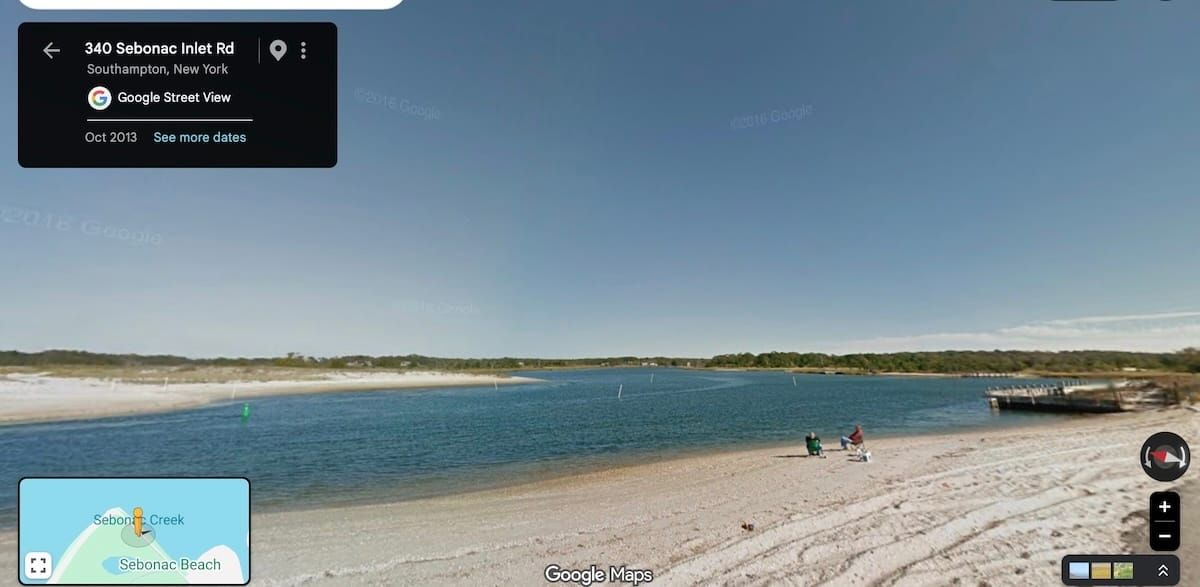
In light of the recent drowning and death of Kiara Paolasin at a beach over the July 4th weekend, I did a virtual study of this beach as we had no data available. Our volunteer community scientists need to go out in the field and complete a survey. Because of this alarming news, I began questioning how a child could drown at a beach I never heard of and felt an urgent need to do something. When volunteer reports come in, I review and vet them for accuracy, also asking followup questions as needed. A laborious job that could take up to 4 or more hours. Maybe I could do something to prevent another tragedy or at least discover something new based on our reporting methods, despite being at home and not in the field.
This is what I discovered. There is no beach on Sebonic Creek Inlet road. It's mixed ownership includes the Town of Southampton who also maintains a permitted parking area, and the National Gold Links of America. Ecologically there is beach habitat, but no beach in the way you'd expect. That is, it has no lifeguards, restrooms, showers, etc. What exists there is a road, a sandy shoreline, and the inlet. Tidal currents are stronger in our inlets. The tide was still going out according to my research, and not slack. Cobble shorelines were present.
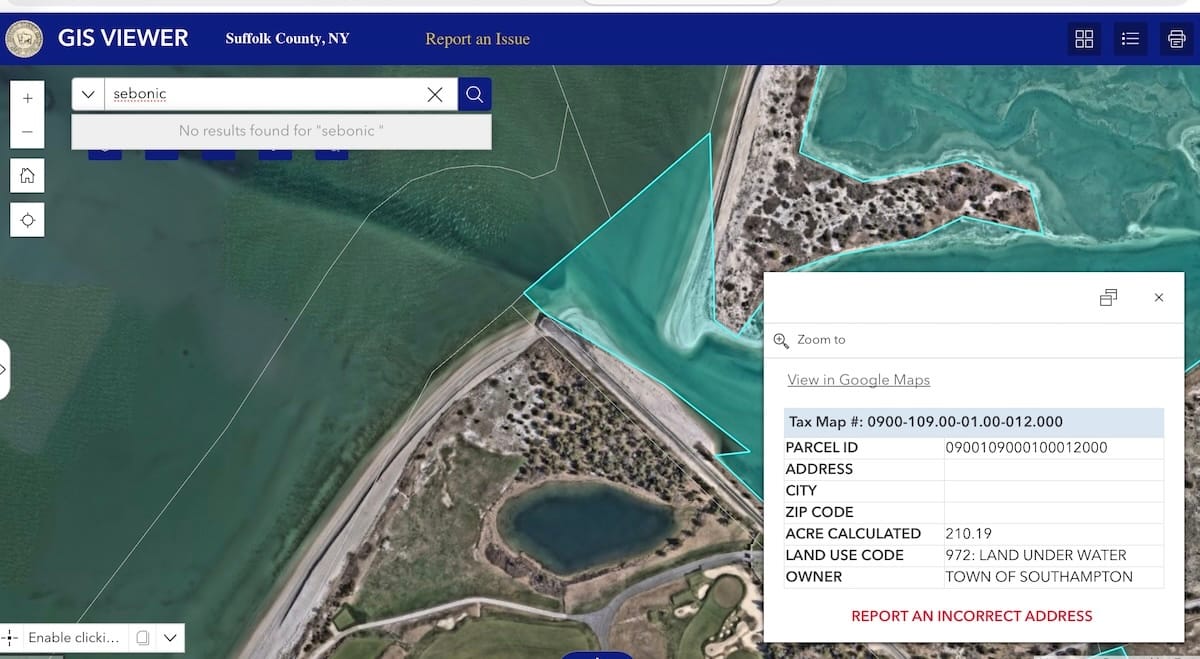
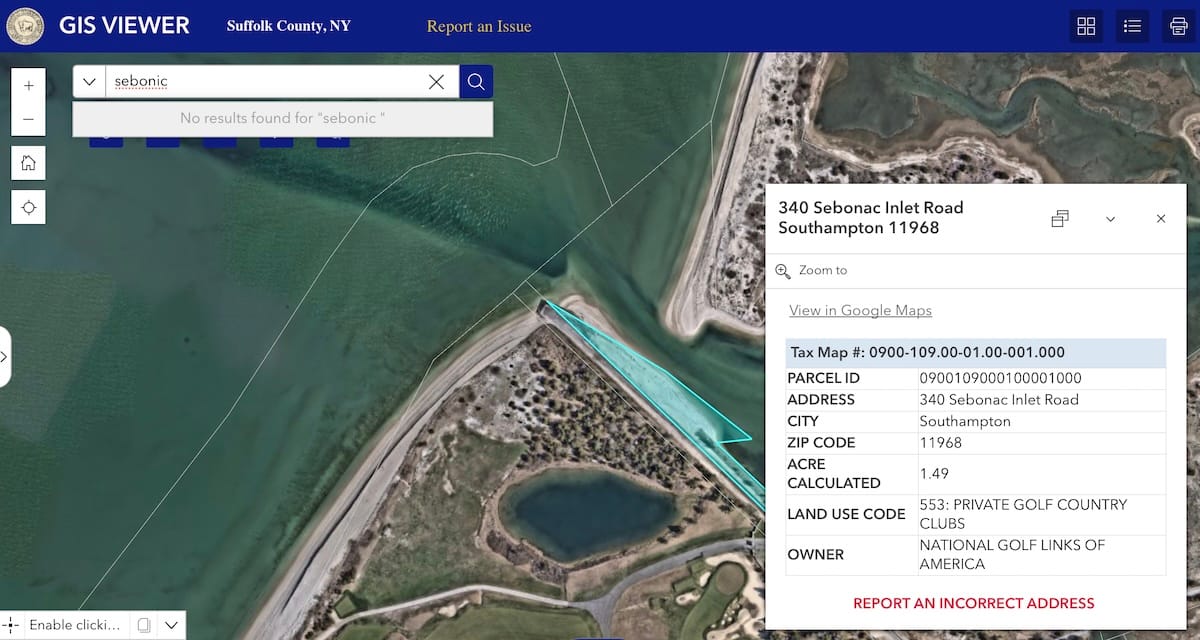
These are the related park resources responsible for the parks. Parks can be open spaces or natural areas. Resources can be private, agencies, nonprofits, civic associations, groups, individuals. Images: Suffolk County GIS.
When working with volunteers I usually spot something that they misunderstand. That's what takes so much time in reviewing their work. And why Quality Parks needs more funding to continue this program. I digress. In this case, I misunderstood currents and warnings. So many of our beach signs warn us about rip currents on beaches with waves, that is, ocean beaches. Whereas, tidal currents are "a whole different animal." I remember Ray and I being caught up in tidal currents at Stony Brook Harbor. The tidal currents flipped our kayaks and luckily we pulled ourselves out on to a dock. At other times, I got caught up in strong winds and tidal currents having to walk my kayak around on the shoreline to quieter waters or turn the boat around and struggle to paddle back to shore safely. These are the kinds of experiences you gain by spending time in and on the water, giving you a reason to be more cautious.
For those with less experience or for those visiting unfamiliar waters, signage would help, particularly for tidal currents. Though there's plenty of rip current signage for ocean beaches, I've only seen one for tidal currents: a sign in Florida that posted a strong current warnings. What if we could combine tidal current warnings with natural history interpretation, including an explanation of tidal charts? With sponsored funding, Kiara's inspired help, and our shared local knowledge of Long Island inlets, we could then further safeguard public access.
Quality Parks is looking for donations to keep writing about local park related topics as well as actions to safeguard public access. Please consider a donation.